- 08-09-2026
- Computer Vision
An accurate AI model is only one component of a reliable operational system.
Artificial intelligence is increasingly being introduced into environments where the information it produces can influence important operational decisions. Wildfire monitoring, environmental protection, transport, energy infrastructure and industrial operations are just some of the areas where AI can help organisations monitor complex environments and identify potential events earlier.
As these technologies become more capable, discussions about their performance often focus on familiar metrics such as accuracy, precision, recall, detection rates and false positives. These measurements are important. They provide a way to evaluate whether a model can recognise the patterns it was designed to identify.
However, when AI is deployed in a critical operational environment, model performance is only part of the picture.
A monitoring system does not operate inside a benchmark or a laboratory. It operates through cameras, networks, interfaces and operational workflows, and its outputs are ultimately interpreted by people who need to decide whether and how to act.
An accurate AI model is only one component of a reliable operational system.
Accuracy is not the same as operational reliability
Consider two monitoring systems that identify the same potential wildfire event.
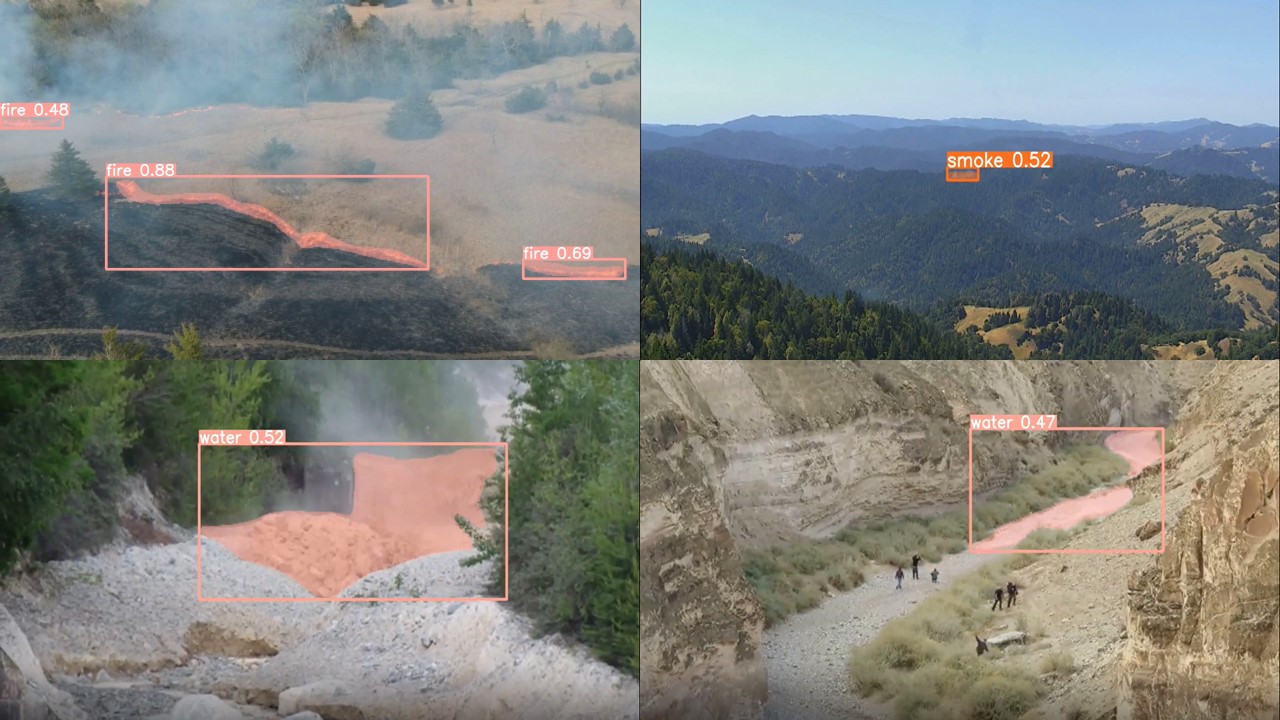
Both detect a possible smoke plume and generate an alert. From a technical perspective, their detection performance may be similar. The experience for the operator, however, can be very different.
One system may simply generate a notification indicating that possible smoke has been detected. The operator must then locate the relevant camera, review the available imagery and determine whether there is enough information to understand the situation.
Another system may present the detection together with the relevant visual evidence, its location and information showing how the suspected event has evolved over time.
The underlying AI model may have identified the same visual pattern in both cases. Yet the operational value of the information is not necessarily the same.
The difference lies in what happens around the detection.
This is an important distinction when evaluating AI systems. A model can perform well at recognising an event while the broader system still creates unnecessary work, provides insufficient context or does not fit naturally into the way operators assess incidents.
For organisations using AI in critical environments, the relevant question therefore extends beyond how well the model performs. It also includes how effectively the complete system supports the people who need to use its output.
Real-world monitoring requires systems that handle uncertainty
AI models are developed using examples of the situations they are expected to recognise. Real-world environments, however, are constantly changing.
In wildfire monitoring, the appearance of a landscape can vary significantly depending on the time of day, season and weather conditions. Visibility may be affected by fog, rain or haze. Smoke can appear differently depending on distance, lighting, wind and the nature of the fire. Other phenomena, including clouds, dust or steam, may occasionally resemble the visual characteristics that a system is designed to identify.
These conditions are not unusual exceptions. They are part of real-world operation.
A system designed for continuous monitoring must therefore be able to function in an environment where the quality and interpretation of visual information can change over time. Deployment also introduces challenges that may not be fully visible during model development. Cameras, connectivity and environmental conditions can all affect how a monitoring system performs.
This does not mean that AI cannot be useful in these environments. In fact, the complexity of continuous monitoring is precisely where AI can provide significant value.
However, not every event can be classified immediately with complete certainty.
A distant smoke-like formation may require further observation. Changing visibility may make an event difficult to interpret. The information available at the moment of the first detection may justify further investigation without being sufficient to determine the appropriate response.
A well-designed monitoring system should account for this reality.
The purpose of AI is not necessarily to eliminate uncertainty. Its value may instead lie in identifying information that deserves attention and helping operators investigate it more efficiently.
For example, an initial detection may become more meaningful when an operator can observe how a suspected smoke plume develops over the following minutes. A single image can provide an indication, while continuous observation may reveal whether the event is increasing, dispersing or disappearing.
A reliable system does not eliminate uncertainty. It helps people manage it.
Context and human judgement determine the value of detection
When an AI system generates an alert, detection is only the beginning of the operational process.
The person receiving that information needs to understand what has been identified, where it was detected and what evidence is available to support further investigation.
This is where the concept of explainability becomes particularly relevant.
Explainability is often discussed in terms of understanding how an AI model reaches a particular conclusion. While this is an important technical and governance issue, the operational requirement is often more practical. An operator does not necessarily need a detailed explanation of the mathematical processes inside a neural network.
What they need is useful context.
Relevant imagery or video, location, previous observations and information about how an event is evolving can all help the operator assess whether further action is required.
The objective is not to make the AI appear to make the decision. The objective is to provide the information needed for people to make better-informed decisions.
AI and human operators contribute different capabilities to this process.
AI can continuously analyse large volumes of information and identify patterns or changes that deserve attention. Human operators can consider local knowledge, operational priorities, available resources and wider circumstances that may not be represented in the data available to the system.
The most effective approach is therefore not simply to automate as much as possible.
It is to design the workflow so that human attention is focused where judgement creates the greatest value.
Trust is built through operation, not simply through metrics
An accuracy figure can provide useful information about how a model performed during evaluation. It cannot, by itself, determine how an organisation will experience the system in daily operation.
Trust develops through repeated use.
Operators observe how the system behaves under different environmental conditions. They become familiar with the types of events that generate alerts and understand when additional verification may be required.
Real-world operation also provides valuable feedback for the organisation developing the technology.
New environmental conditions can reveal edge cases that were not sufficiently represented during development. Operational experience may show that information should be presented differently or that certain workflows can be improved.
For this reason, AI systems used in critical environments should not be viewed as completely finished at the moment of deployment.
Deployment is also part of the learning process.
The system, the models and the operational workflow can continue to improve as new experience and information become available.
In critical AI systems, trust is not installed. It is earned through operation.
Designing around the complete operational workflow
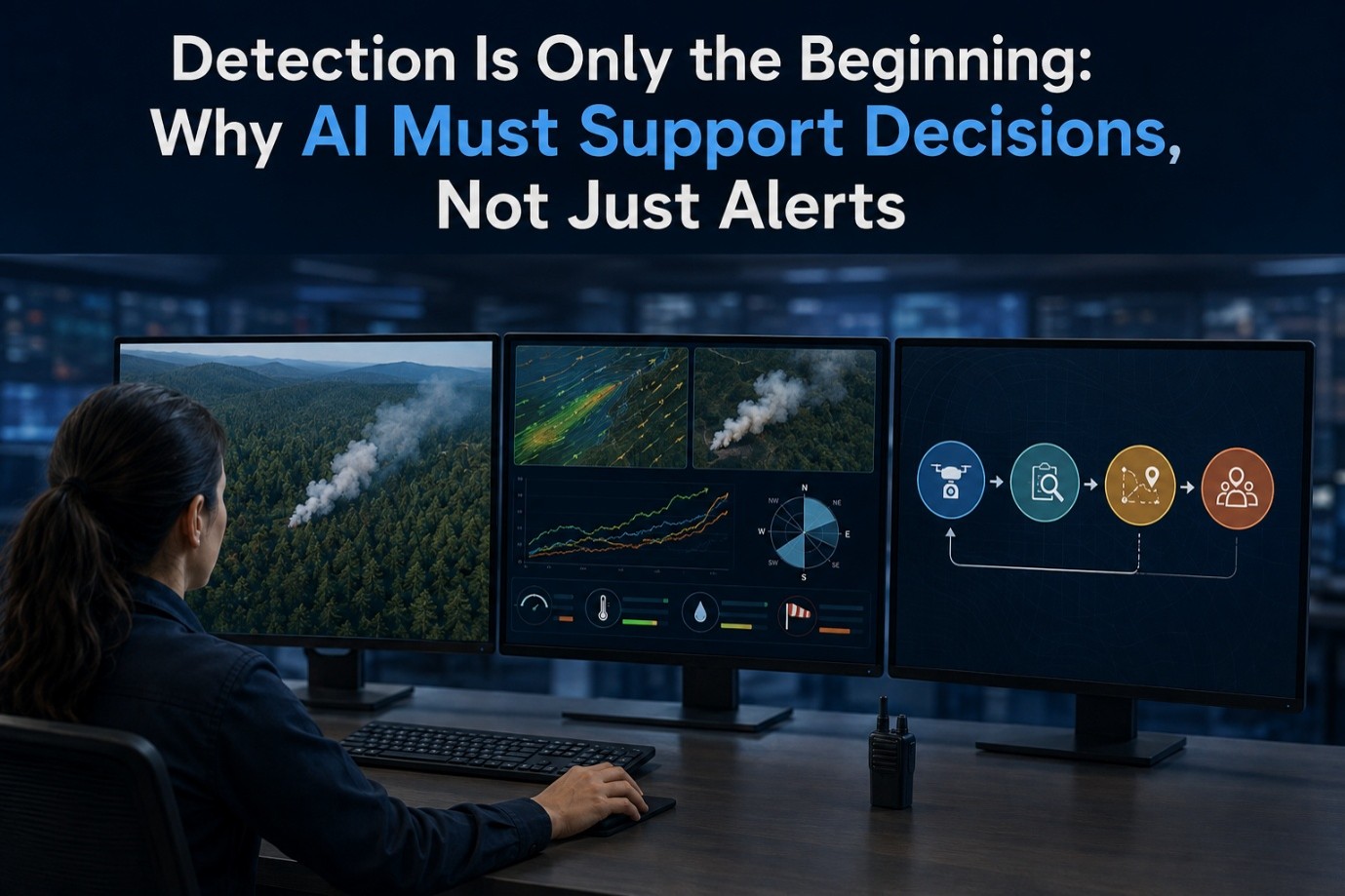
One of the most useful ways to approach AI-powered monitoring is to consider the complete lifecycle of an event rather than focusing exclusively on the moment of detection.
A typical process may involve:
Monitoring -> Detection -> Validation -> Assessment -> Decision -> Review
Each stage has different requirements.
Detection identifies something that may deserve attention. Validation helps determine whether the event is credible. Assessment places the available information in a broader operational context, while the decision determines what action, if any, should follow.
The AI model is an important part of this process, but it is not the entire process.
Thinking about AI in this way changes how systems should be designed. Instead of asking only whether the technology can detect an event earlier, organisations can also consider what information will be required after detection, how uncertainty can be reduced and how the system can support the people responsible for the next decision.
This is where AI-powered monitoring moves beyond automated recognition and becomes part of an operational decision-support system.
Conclusion
AI has the potential to improve how organisations monitor complex and critical environments. Continuous analysis can help identify events that might otherwise take longer to notice and direct human attention towards situations that require further investigation.
However, the transition from an accurate AI model to a reliable operational system involves more than improving performance metrics.
It requires consideration of uncertainty, context, human judgement and the complete workflow surrounding an alert. It also requires systems to evolve through real-world experience, where new conditions and operational challenges will inevitably emerge.
As AI becomes more deeply integrated into critical operations, the most valuable systems will not simply be those that generate the highest number of detections.
They will be the systems that provide information in a form that helps people understand what is happening and make better decisions.
Because, ultimately, an accurate AI model is only one component of a reliable operational system.